


 |
||||||||||||||||||||||||||||||||||||||||||||||||||||||||
Use of protected acids in poultryGood gut health is a pre-requisite to good bird performance. As the growth period is progressively shortened and feed efficiency continuously improved, the health and nutrition of the bird are becoming more demanding. Health of the gastrointestinal tract is an issue which is especially important for young birds. There are several possibilities to influence gut health. Butyric acid is known to be a very efficacious feed additive for this purpose. Protection of acids There are several products on the market providing salts of butyric acid in both protected and unprotected forms. Due to the unpleasant persistent odour of butyric acid, protection makes the handling of the product easier. Another reason for protection is to obtain gastric by-pass of butyric acid and subsequent release of the active substance in the small intestine. Encapsulation of acids is a known form of protection, however butyric acid content in well encapsulated products can be only relatively low as high amount of fat is needed for a proper protection. The most beneficial protection is in the form of glycerides which is a chemical compound of acids and glycerol. The advantage of this protection is that the product contains a high amount of active ingredient - about 78%. The glycerol acid compound is not influenced by the pH of the stomach; therefore these compounds reach the small intestine, where the gradual release of the undissociated acids through the action of lipases takes place. It is known that protected butyric acid is an excellent growth promoter as it is an efficient nutrient for the intestinal mucosa. It leads to an increase in the density and length of the villi, enlarging the absorptive surface of the intestine. Literature describes the positive effects of butyric acid on breeder and layer production performance and on egg shell quality. Butyric acid is also known as an antibacterial agent against pathogenic micro-organisms including salmonella, clostridia, Escherichia coli etc and as a modulator of the intestinal flora supporting beneficial micro-organisms such as lactobacilli. Butyric acid enhances the reparation of gut wall lesions caused by intestinal diseases and nutritional imbalances. Moreover, butyrate stimulates gastric secretion, thereby improving protein and fat digestibility. Effect of butyric acid glycerides on metabolizable energy A trial was carried out by Dr. S. Leeson, Department of Animal & Poultry Science, University of Guelph, Canada. One hundred and twenty-eight one-day old commercial male broiler chicks were assigned to two crumble diets, designated as a control and a trial group. The trial group received a mixture of mono-, di-, and triglycerides of butyric acid, at the level of 0.2%. Each treatment consisted of 8 replicated cages with 8 chicks each. Chicks were housed in an electrically heated brooder for the first 18 days. At day 18, 3 chicks from each cage were moved to grower cages. Brooding temperature was 32° C for first five days and then gradually reduced to 22° C in keeping with normal brooding practice. Birds were given 23-hour lighting throughout the experimental period. Chicks were fed starter diet from day 1 to 18 and grower diet from day 18 to 38. Excreta were collected from day 9 to 12 and day 35 to 38 to estimate metabolizable energy. Birds received their diets and water ad libitum. Growth performance was measured from day 1 to 18. Diets and excreta were analyzed for gross energy using an adiabatic, oxygen-bomb calorimeter and nitrogen using the Kjeldahl procedure (AOAC, 1990). Data were analyzed by t-test (SAS Institute, Inc. Cary, NC, USA). Dietary supplementation with butyric acid glycerides in the broiler starter diet significantly increased (P<0.01) dietary AMEn (Apparent Metabolizable Energy) measured over a period from day 9 to 12 (Table 1). The AMEn measured over a period from day 35 to 38 was not significantly different, although AMEn of the diet supplemented with butyric acid glycerides supplemented diet had 50kcal more AMEn than the control. Weight gain and feed intake of birds fed the diet containing butyric acid glycerides were slightly higher than those of the control group. This result shows that supplementation of broiler starter diet with butyric acid glycerides increases diet AMEn. Table 1. Efficacy of butyric acid glycerides on AMEn and growth performance in broilers
Efficacy of butyric acid glycerides in reducing intestinal colonization of Salmonella enteritidis This trial was carried out by Dr. Paola Massi at Public Animal Health Institute of Forlì, Italy, 2006 The trial design consisted of 5 treatment groups of 20 broiler chicks in each group. Each treatment group was offered a different quantity of butyric acid glycerides (0%, 0.2%, 0.4%, 0.7%, 1%) absorbed on silica. At 12 days of age (day 0) all birds were infected by endoesophageal way with 44*109 CFU of S.enteritidis. 24 hours after infection cloacal tampons were performed on all subjects to verify the establishment of S.enteritidis infection. On day 3, 5, 8, and 11, five birds of each group were sacrificed. The caeca were removed from each animal and tested to determine the count of S.enteritidis. Absence of S.enteritidis antibodies was determined with an ELISA test (IDEXXÒ). All birds were seronegative to S.enteritidis 24 hours after infection. All levels of butyric acid glycerides succeeded in reducing Salmonella in the caeca, compared to the control (0% butyric acid glycerides) group. Results of the bacterial counts determined in the caeca are reported in Figure 1. 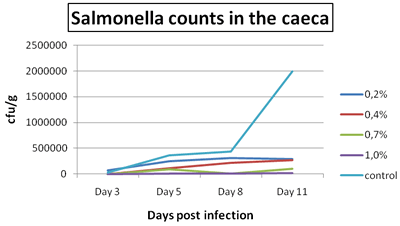 Figure 1: Salmonella counts in the caeca. Field trial with 3 600 000 birds Ross 508 chickens The aim of this study was to investigate the effectiveness of butyric acid glycerides in broiler chickens. Butyric acid glycerides were tested against a negative control under farm conditions. The trial was conducted in a private commercial farm in Italy. 3 600 000 Ross 508 chickens were divided into 2 groups. Both groups received the same commercial broiler diet. The experimental diets were fed for 42 days. The control group received no growth promoting feed additives. The trial group received butyric acid glycerides at inclusion level 0.2 % from day 1 to day 21 of age. The data recorded during the present trial are shown in Table 2. Table 2. Effect of butyric acid glycerides on growth performance in poultry
As it can be seen from the table, weight gain was better in the trial group which was fed with butyric acid glycerides. Feed intake was improved by 13 % in this group. As butyric acid glycerides do not posses the palatability enhancing properties it is assumed that birds were facing some digestive problems which could be positively influenced by butyric acid. Therefore chickens in the trial group with butyric acid glycerides were able to get more feed and transfer it into improved weight. Due to high improvement of feed intake, FCR is lower in the control group in comparison to the group fed butyric acid glycerides. The combination of butyric, caprylic and capric acids in the protected glycerides form optimize the influence of butyric acid Glycerides allow all acids to act as antibacterials in the intestine, with caprylic and capric acids showing very strong antimicrobial activity in the higher pH value of the intestine. Moreover, glycerides containing butyric acid and medium chain fatty acids possess a nutritional value which is especially important for young animals. Medium-chain fatty acids, which are saturated fatty acids mainly composed of 8-10 carbons (caprylic and capric acids), have unique nutritional characteristics different from those of long-chain fatty acids. Medium-chain triglycerides (MCT) are more readily digested and absorbed than long-chain triglycerides (LCT), and easily utilized as energy. Challenge trial with Clostridia The influence of glycerides of butyric, caprylic and capric acids on growth performance of broiler chickens was described by Antongiovanni et al. (2005) by means of a challenge trial with Clostridium perfringens 5x10⁵ CFU and Eimeria acervulina 103 oocysts. The application dosage of butyric acid glycerides and glycerides of butyric, caprylic and capric acids was 2 kg/t feed and 1.5 kg/t feed respectively. 10ppm avilamycin was used as a positive control group. The summarized results of the trial are shown in Table 3. Table 3. Effect of butyric, caprylic and capric acids on growth performance in poultry
The outbreak of necrotic enteritis in all groups was visible after the infection at the third week but birds fed with glycerides had better performance than the negative and positive control groups. The improvement of final body weight, average daily weight gain (ADWG) and feed conversion rate (FCR) of the group fed with glycerides of butyric acid and glycerides of butyric, caprylic and capric acids was around 11% and 14% respectively, compared to the negative control group. The increased resistance of chickens in the groups containing glycerides of butyric, caprylic and capric acids to the infection is due to:
Optimizing gut health is a key to improving animal performance. Young birds need support to develop and maintain a healthy microflora in their intestinal tract. Innovative products, such as the protected form of butyric, caprylic and capric acids are a tool that can be used to optimize poultry performance. For Further Product Information Please Visit www.biomin.net |
Featured Products Biotronic®Naturally ahead in dynamic acidification!Related Articles Biotronic®Efficiency of Biotronic® Product Line in PoultryBiotronic®Ascites in poultryBiotronic® GutpowerAchieving a healthy gut for a top broiler performanceBiotronic® GutpowerInnovation on the horizonBiotronic® GutpowerUse of protected acids in poultryAsk The Experts Ask The ExpertsOur poultry experts answer your questions.Related Services Mycotoxin ChannelWorld renowned experts answer mycotoxin related questions. Mycotoxins.infoA wealth of Mycotoxin information at your fingertips. World Nutrition ForumThe future of animal nutrition B.R.A.I.N ProgramBiomin Research and Innovation Network | |||||||||||||||||||||||||||||||||||||||||||||||||||||||
|
BIOMIN Holding GmbH Industriestrasse 21, 3130 Herzogenburg, Austria/Europe ATU56585323
Tel.: +43 2782 803, Fax: +43 2782 803 30 e-mail:[email protected] |
||||||||||||||||||||||||||||||||||||||||||||||||||||||||
 © 2000 - 2021. Global Ag MediaNinguna parte de este sitio puede ser reproducida sin previa autorización.
Términos y Condiciones | Privacidad | Renuncia